

On March 4th, China’s annual “two sessions” convened in Beijing. As a major event in the country’s political life, the gatherings attract widespread attention both at home and abroad every year. The 2026 “two sessions” are particularly significant as they mark the opening year of China’s 15th Five-Year Plan, signaling the direction of the country’s economic and social development not only for this year but for the next five years.

On December 21, 2025, the 2025 Guangzhou Marathon kicked off(Photo: Xinhua News Agency)
China’s economic growth target is steady and pragmatic
As the world’s second-largest economy, China’s annual economic growth target serves not only as the central guide for domestic macroeconomic policies but also as an important window for the world to observe China’s development trajectory and assess global economic trends. For 2026, China has set its gross domestic product (GDP) growth target within a range of 4.5% to 5%, while striving for even better results in practice. To understand this target, one must look beyond the numbers and consider the multiple implications behind it.
While interpreting the target, Shen Danyang, head of the government work report drafting team and director of the State Council Research Office, stated that this year’s growth target takes into account both domestic economic conditions and shifts in the external environment. It strikes a balance between what is needed and what is feasible and represents a proactive and pragmatic growth target, reflecting both ambition and prudence.
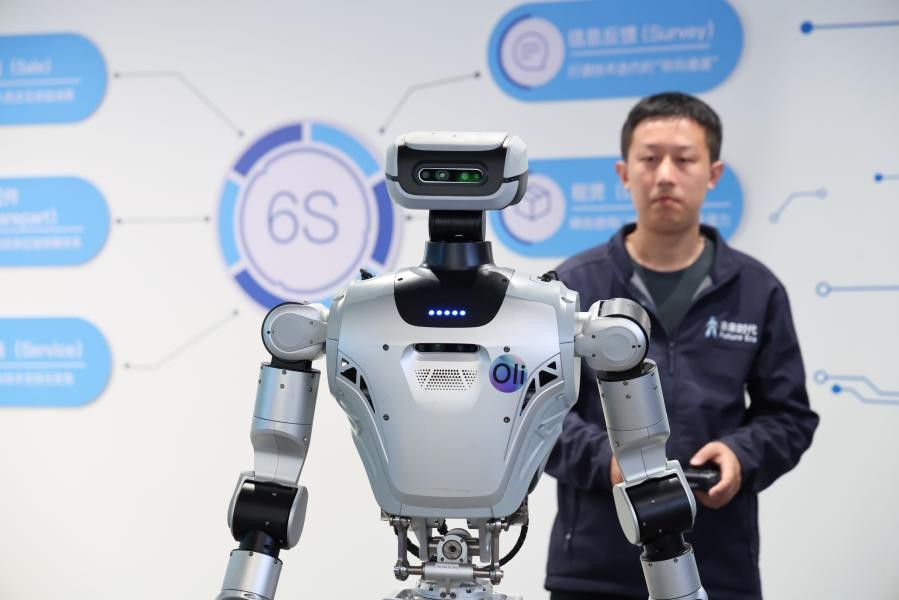
At the world’s first robot 6S store in Shenzhen, staff showcased a humanoid robot(Photo: Liang Xu/Xinhua News Agency)
China has made it clear that by 2035, its per capita GDP should reach the level of a moderately developed country. According to expert estimates, working backward from the long-term goal of raising per capita GDP to over 20,000 US dollars by 2035 and doubling the 2020 level, China would need an average annual growth rate of above 4.17% over the next decade to achieve this target.
This year’s growth target also marks a shift back to a range after China set its target at “around 5%” for three consecutive years. Previously, China set a growth target of 6.5% to 7% in 2016 and achieved 6.8%, and in 2019 it set a target of 6% to 6.5% and achieved 6.1%, both surpassing the lower end of the target range.
Setting the growth target within a range leaves greater policy space for China to respond to uncertainties such as geopolitical risks and rising protectionism. Koh King Kee, a senior Malaysian scholar and president of the Centre for New Inclusive Asia, said that “this pragmatic target reflects both stability and flexibility in China’s policymaking.”
Liang Guoyong, a senior economist with the United Nations Conference on Trade and Development, said that setting the expected growth target as a range demonstrates the pragmatism and flexibility of China’s economic policy, providing greater room to maneuver in response to external challenges such as global geopolitical turbulence and disorder in international economic governance.

At a nursing home in Shenzhen, an elderly person interacts with the humanoid robot “Xialan”((Photo: Liang Xu/Xinhua News Agency)
Rahma Gafmi, an economics professor at Indonesia’s Airlangga University, said that looking ahead to the entire 15th Five-Year Plan period, the significance of China’s growth target “lies not in the number or the range itself, but in setting the tone for development over the next five years: on the one hand, creating conditions for reform, transformation, and risk resolution through a reasonable growth rate; on the other, basing growth more firmly on expanding domestic demand, improving total factor productivity, and strengthening capability for sci-tech innovation.”
APEC Economic Leaders’ Meeting in Shenzhen draws global attention
The year 2026 marks the APEC China year. In November, the 33rd APEC Economic Leaders’ Meeting will be held in Shenzhen, Guangdong. The theme for APEC 2026 is “Building an Asia-Pacific Community to Prosper Together,” with three priorities: openness, innovation, and cooperation.
As China’s largest provincial economy and a frontier of opening up, Guangdong serves both as a key engine of China’s economic growth and as a major platform for the country’s participation in the Asia-Pacific cooperation. By deepening trade ties, industrial collaboration, and sci-tech innovation exchanges with APEC member economies, Guangdong has helped local companies expand into Asia-Pacific markets while attracting significant foreign investment, technology, and talent from APEC members, directly supporting steady economic growth.
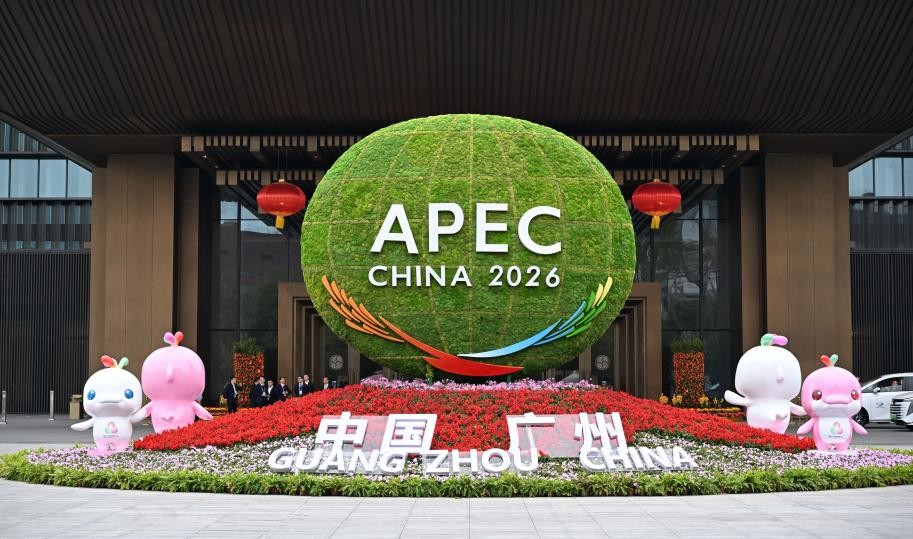
The first APEC Senior Officials’ Meeting in 2026 was held in Guangzhou, Guangdong(Photo:Deng Hua/Xinhua News Agency)
Having visited Shenzhen multiple times, Koh noted three lasting impressions of the city: the speed of innovation, the deep integration of technology into urban governance, and robust advanced manufacturing capabilities.
Koh believes that Guangdong’s industrial cluster advantages in fields such as 5G, artificial intelligence, the industrial internet, new energy vehicles, and photovoltaic manufacturing can connect seamlessly with Malaysia’s regional role as an advanced manufacturing hub, digital services hub, and sustainable finance hub within the Association of Southeast Asian Nations (ASEAN). He expressed hope that, in terms of supply chain complementarity, Malaysia can leverage the APEC mechanism to promote the mutual recognition of standards and trade facilitation. This will allow the country to more closely link its strengths in fields such as electrical and electronics and semiconductors with the advanced manufacturing base of the Guangdong-Hong Kong-Macao Greater Bay Area represented by Shenzhen.
Su Jian, a professor at Peking University’s School of Economics and director of its National Center for Economic Research, said that supporting the APEC meeting well presents an important opportunity for Guangdong to advance institutional opening up. “On the one hand, the gathering of political and business leaders from different countries brings diverse information and ideas, helping Guangdong better align with international rules. On the other hand, hosting a major international event itself raises higher requirements for urban governance and industrial support systems. This ‘anti-driving mechanism’ will accelerate the intelligent upgrade of traditional industries and promote reform and development through greater openness.”
China has hosted APEC three times, from Shanghai to Beijing and now to Shenzhen. The 25 years spanning these events outline a clear trajectory of China’s integration with the world. Shenzhen in 2026 will showcase China’s global leadership in sci-tech innovation and new heights of reform and opening up. For the international community, whether following the APEC Shenzhen or interpreting China’s new economic growth target, both offer insights into the future direction of the Chinese economy.
Reporter: Fu Yi, Zhao Peng